We build
systems.
Not scenery.
Custom business applications, commerce integrations, SaaS products and production infrastructure for SMEs and growing digital businesses, from product design to operations.

You do not need another tool. You need connected operations.
Technology creates value when it removes uncertainty between systems and owners.
Commerce, inventory and internal operations live in disconnected systems.
Manual processes consume time and create avoidable errors.
The product is growing faster than its architecture.
Production is running, but monitoring and ownership remain unclear.
Four pillars, one system of ownership.
Product Engineering
Turn fragmented workflows into an extensible business system.
Custom applications, SaaS, APIs and permission models.
Testable releases · Python · Flask · PostgreSQLCommerce & Integrations
Connect commerce, inventory, order and payment data.
Dependable integration and synchronisation workflows.
Vezoryx · Stripe · webhooks · idempotencyDevOps & Production Operations
Replace uncertain releases and unclear monitoring.
Reproducible delivery and observable production operations.
AWS · Docker · Nginx · Gunicorn · CI/CDBrand, UI & Visual Systems
Make complex operations understandable at the interface.
Accessible UI and a coherent visual system within delivery.
Design systems · responsive UI · DTPThe best proof of engineering: a working product.
Vezoryx is the studio’s modular, multi-tenant business SaaS product for Hungarian SMEs.
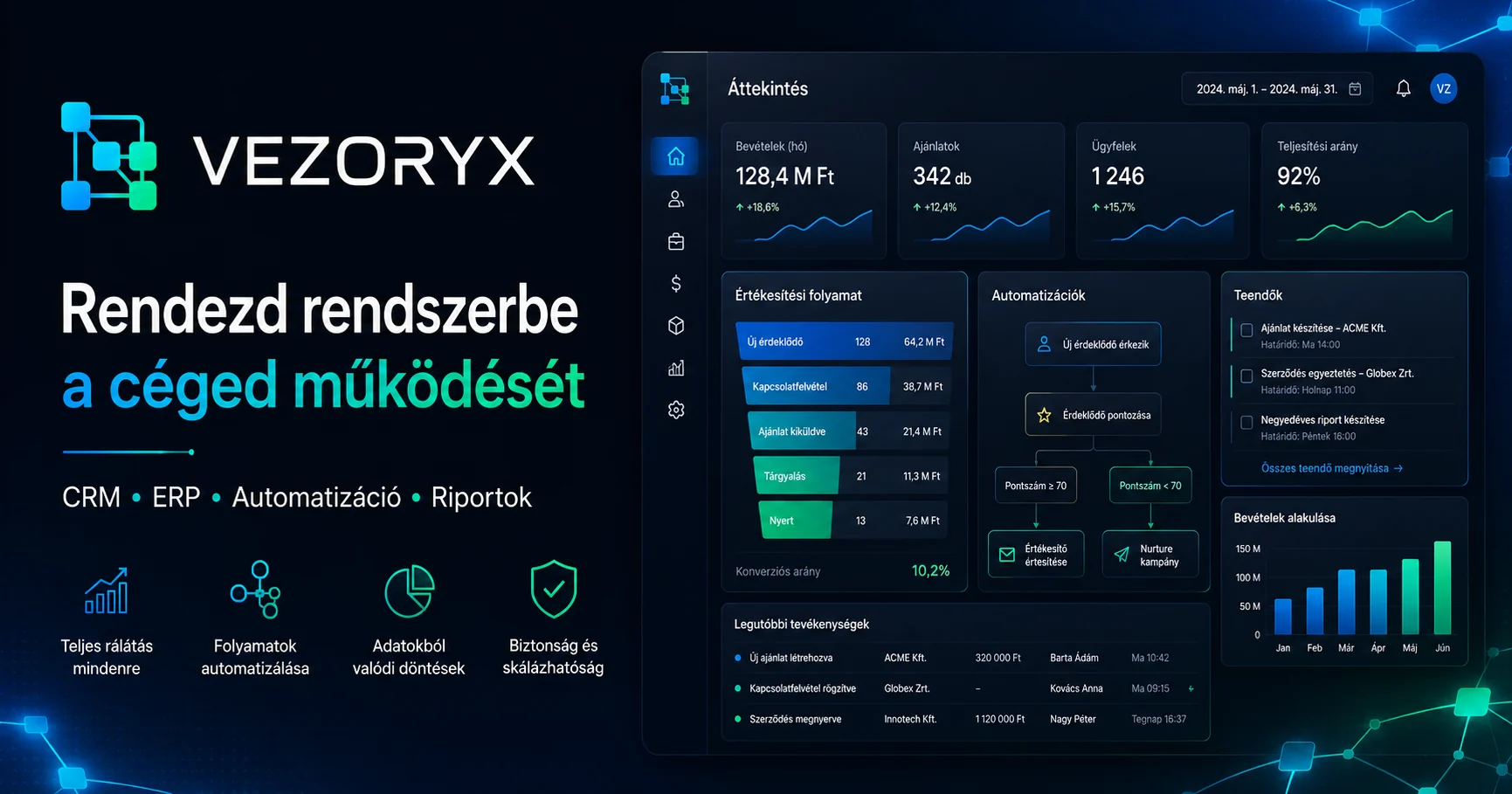
Operations software for Hungarian SMEs.
CRM, inventory, orders, workflow and webshop integration in one modular platform.
Open product ↗Multi-tenant
Tenant isolation, modular rollout and integration layer.
Production
CI/CD, monitoring, rollback, auditable releases.
Inventory API
Webshop sync, outbox, idempotency and inventory master.
Continuous
Iterative development shaped by real business use.
Work, not thumbnails.
SaaS, production commerce and systems integration—different problems, the same end-to-end ownership.
SaaS · Product engineering · DevOpsVezoryxModular business operations platform.
 Custom commerce · Inventory sync · Stripe · Production operationsTutto MarconiProduction commerce, integrated with Vezoryx.
 Commerce · Brand · PaymentsEva Miller LingerieCustom premium commerce and operations.
 Rebuild · Flask · InfrastructureMyLuxHomeLegacy rebuild and production stabilisation.
01 / 07
From the problem to a precise system map.
Workflow discovery, objectives and technical risks before the build.
- Discovery workshop
- Requirements map
- Architecture direction
An interface that makes operations legible.
Prototype, design system and responsive components in an extensible system.
- Interaction design
- Responsive UI
- Accessible components
Business rules in a dependable architecture.
APIs, permissions and transactional workflows that remain safe to evolve.
- Domain modelling
- REST integrations
- Authentication and transactions
Systems that exchange real operational data.
Payments, catalog, analytics and search tooling through an observable integration layer.
- Payment lifecycle
- Catalog synchronization
- Analytics and merchant feeds
A reproducible route to production.
Containers, Linux runtime, proxy and cloud infrastructure with clear ownership.
- Container runtime
- Reverse proxy
- Cloud architecture
Deployment is not the end of the project.
Automated releases, rollback and continuous operations make a system a production product.
- Versioned delivery
- CI/CD pipelines
- Operational handover
One connected engineering system.
Product, infrastructure and visual systems connect to the same operational outcome.
- Continuous improvement
- Visual communication
- Long-term ownership
 STACK FLOW
- Figma / XD
- Photoshop
- Illustrator
- JavaScript
- Tailwind
- Bootstrap
- Jinja
- Python
- Flask
- Java
- PostgreSQL
- Stripe
- Google Analytics
- Merchant Center
- Search Console
- Docker
- Linux
- AWS
- Nginx
- Gunicorn
- GitHub
- GitHub Actions
- Jenkins
- Blender
- DaVinci Resolve
- InDesign
- Canva
From briefing to measurable production operations.
Five connected phases, one end-to-end line of accountability.
Discovery & requirements
We begin with the business problem that must be solved, not with a technology choice.
Through remote or in-person discovery we map objectives, user needs, required capabilities, integrations, deadlines and business constraints. We identify risks, dependencies and the scope required for the first production-ready release.
- 01Structured project brief
- 02Objectives and scope definition
- 03Functional requirements
- 04Integration map
- 05Risk register
- 06First-release proposal
- 07Schedule and priority plan
Design & architecture
We design the interface, business logic and infrastructure as one coherent system.
We create wireframes, user journeys, UI concepts, data models and technical architecture. Frontend, backend, database, integration boundaries and production infrastructure are designed to operate together.
- 01User flows and information architecture
- 02Wireframes and UI system
- 03Backend and module boundaries
- 04Data model
- 05API and integration contracts
- 06Permission model
- 07Deployment architecture
- 08Test and release strategy
Development & iteration
The system is built as working, testable increments.
Frontend, backend, database logic, APIs, integrations and automation are implemented together. Each increment is checked against the business workflow it is intended to support.
- 01Working frontend and backend
- 02Domain and transactional logic
- 03REST APIs and external integrations
- 04Database migrations
- 05Permissions and security layer
- 06CI workflows
- 07Testable release increments
- 08Documented technical decisions
Testing, release & deployment
Development is complete only when the system can be released safely, not when it merely works locally.
Functional, integration, regression, performance and security checks support a controlled CI/CD release with documented migrations, rollback capability and production smoke tests.
- 01Automated tests
- 02Browser and responsive QA
- 03Performance checks
- 04Security sanity checks
- 05Migration plan
- 06Release artifact
- 07CI/CD deployment
- 08Rollback procedure
- 09Production smoke evidence
Operations, support & scale
Deployment is the beginning of real operation, not the end of the project.
Monitoring, defect resolution, security updates, backups, performance tuning and continuous development follow release. The system must scale with business demand without being rebuilt for every new capability.
- 01Health and availability monitoring
- 02Log and incident investigation
- 03Backup and recovery process
- 04Regular updates
- 05Performance tuning
- 06Defect resolution
- 07New releases
- 08Capacity and scaling plan
Clear ownership, delivery that can expand.
Coding Bear Studio is a founder-led product engineering studio. Strategic, technical and quality ownership stays clear while delivery can expand around the needs of the product.
What is useful to clarify before the first conversation.
What projects are a good fit?
Custom business applications, SaaS products, commerce or inventory integrations, and production systems that need stabilising.
Can you take over an existing system?
Yes. We first assess the code, architecture, access model and operational risks.
Do you provide operations after development?
Yes, when ownership, monitoring, backup, release and incident processes can be defined clearly.
Do you work with commerce and inventory integrations?
Yes. We design commerce, order, payment and inventory data flows as one connected system.
How does a project start?
With focused discovery, followed by a proposal for scope, risks and the most useful next step.
How is Coding Bear Studio different from a traditional web agency?
As a founder-led studio, we treat product, integrations and production operations as one system of ownership.